Skip to content

If you’ve ever wondered how many cigarettes are in a pack, the answer seems simple enough at first glance: walk into almost any convenience store in the US and you’ll grab a pack that holds 20. It’s such a fixed part of the retail landscape that most people never stop to ask why that number stuck, or whether it’s actually universal. Turns out, there’s real packaging logic, manufacturing history, and regulatory pressure behind that little box in your pocket.
This guide breaks down exactly how many cigarettes come in a standard pack, why 20 became the default, how packs and cartons relate to each other and where things get different depending on the country or brand. If you work in retail, distribution or packaging itself, you’ll also find the practical details that shape how these products move through the supply chain.
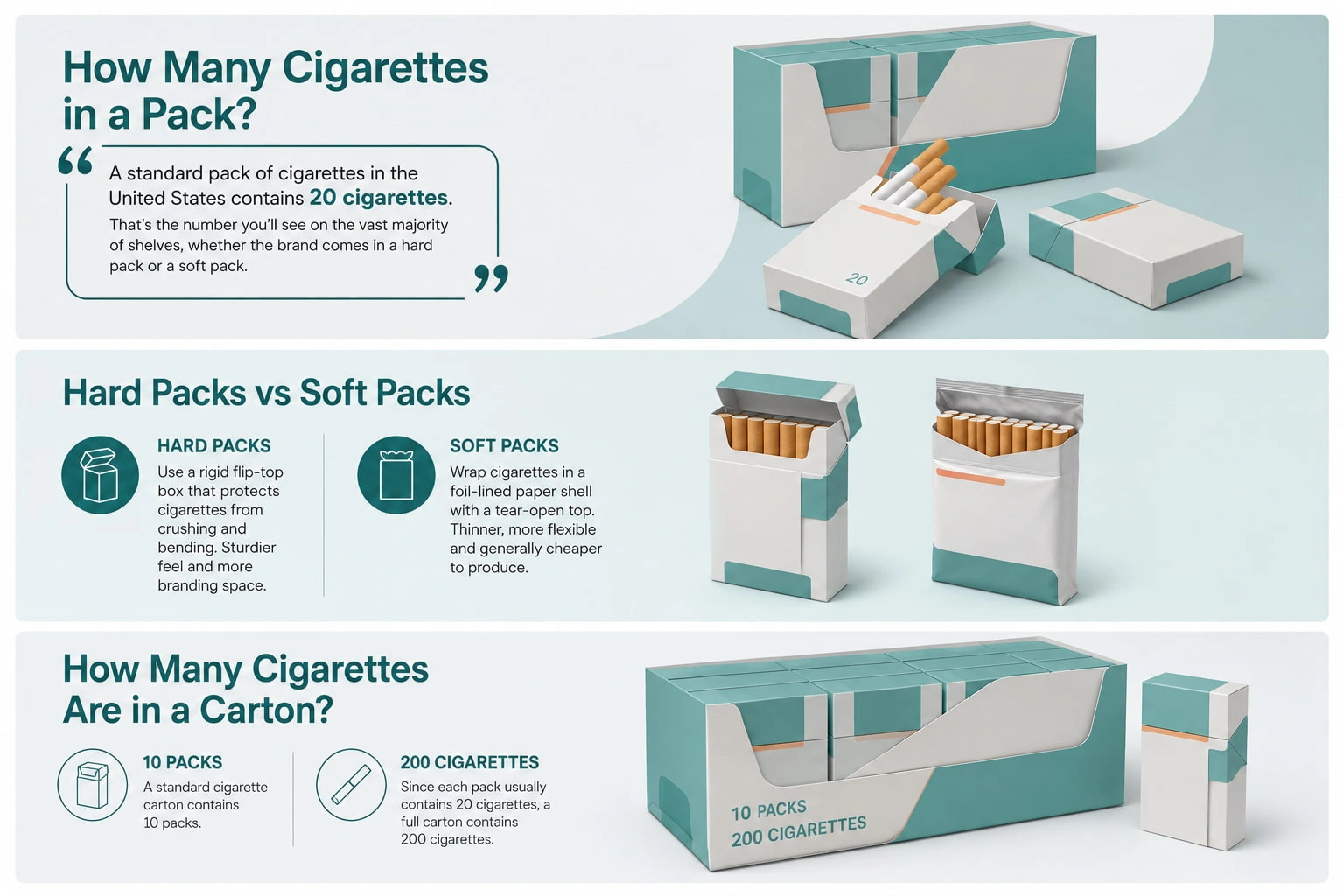
A standard pack of cigarettes in the United States contains 20 cigarettes. That’s the number you’ll see on the vast majority of shelves, whether the brand comes in a hard pack or a soft pack. Some specialty or international variants hold 10, 14, or 25 cigarettes instead but 20 remains the dominant global standard.
Why Most Packs Contain 20 Cigarettes

The 20-cigarette pack didn’t appear by accident. In the early 20th century when the cigarette production moved from hand-rolling to mechanized manufacturing, it grew out of a combination of manufacturing efficiency, pricing psychology and packaging engineering.
Manufacturing Efficiency and Machine Output
Cigarette-making machines developed in the late 1800s and early 1900s could produce and package cigarettes far faster than any manual process. Manufacturers needed a pack size that matched neatly with rolling machine output, kept unit costs low, and still felt substantial enough to justify a retail price point. Twenty landed in that sweet spot: large enough to feel like a reasonable supply, small enough to keep manufacturing and packaging costs manageable.
The Pricing Logic Behind a 20-Cigarette Pack
Pricing played a role too. A pack of 20 divides cleanly for cost calculations and it made per-cigarette pricing easy for both manufacturers and retailers to communicate. Once major brands settled on 20 as their standard, competitors followed to stay comparable on shelf and the number became an informal industry benchmark that regulators and manufacturers alike built later standards around.
Packaging Engineering
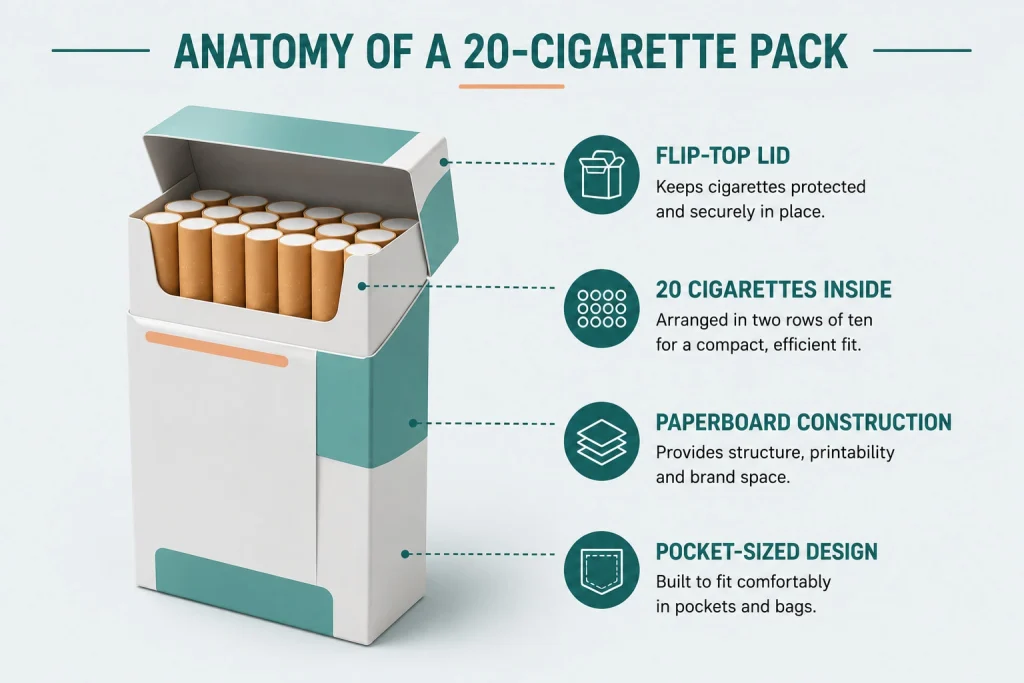
There’s also a packaging engineering reason. Twenty cigarettes arranged in two rows of ten fit efficiently into a compact rectangular box, whether that’s a flip-top hard pack or a folded soft pack. That arrangement minimizes wasted space, keeps the pack pocket-sized, and simplifies the automated packing lines that fold, fill and seal packs at high speed.
Do All Cigarette Brands Have 20 Cigarettes per Pack?
Most mainstream brands sold in the USA stick to 20 cigarettes per pack but it’s not a universal rule. A handful of variations exist:
- 10-packs: Smaller packs of 10 show up in some international markets often for pricing reasons or as a trial size.
- 14-packs: A few regions have used 14-cigarette packs as part of tax or health policy experiments aimed at reducing consumption per purchase.
- 25-packs: Less common today, but historically some brands offered 25-cigarette packs, particularly before certain regulatory standardizations took hold.
In the US, 20 is effectively the retail norm, and most state and federal tax structures are built around that quantity. Outside the US, pack size can shift based on local tobacco control policy, import regulations and manufacturer strategy so the count on the box isn’t something you can assume without checking.
Hard Packs vs Soft Packs
Cigarette packaging generally falls into two categories, and the difference goes beyond looks.
Hard packs use a rigid flip-top box, typically built from paperboard, similar to what you’d find in custom cardboard cigarette boxes, that protects cigarettes from crushing and bending. The flip-top lid opens on a hinge, keeps the remaining cigarettes contained, and gives the pack a sturdier feel in a pocket or bag. Hard packs also offer more surface area for branding, which is part of why premium and flagship product lines lean toward this format.
Soft packs, closer to what’s often sold as custom paper cigarette boxes, wrap cigarettes in a foil-lined paper shell with a tear-open top, no rigid structure underneath. They’re thinner, more flexible, and generally cheaper to produce, but they offer less physical protection. Soft packs still show up in specific markets and among smokers who prefer a slimmer profile, but their market share has shrunk as hard packs became the standard for major brands.
Both formats can hold 20 cigarettes without any difference in retail pricing tied to the packaging type itself. The choice mostly comes down to brand positioning, cost per unit and regional consumer preference.
How Many Packs of Cigarettes are in a Carton?
A standard cigarette carton contains 10 packs of cigarettes. This has been the industry norm for decades and lines up with how cartons are sized, shrink-wrapped, and shipped through wholesale and retail distribution.
How Many Cigarettes Are in a Carton?
Since a carton holds 10 packs and usually each pack contains 20 cigarettes, a full carton contains 200 cigarettes. That figure is consistent enough across US retail that it’s used in tax calculations, wholesale pricing and inventory tracking without much variation.
Can Pack Sizes Differ by Country?
Yes, and the differences aren’t just cosmetic. Based on public health policy, taxation models and import rules countries regulate tobacco packaging differently. Some regions restrict smaller pack sizes specifically to prevent cheaper entry points into smoking pushing manufacturers toward larger standard packs. Others have historically allowed smaller counts as a lower-cost option for price-sensitive consumers.
Packaging regulations in various countries also dictate things like mandatory health warning space, minimum pack dimensions, and even restrictions on colors or branding elements, all of which interact with how many cigarettes a manufacturer can fit into a compliant box. A pack designed for the US market won’t necessarily meet packaging law in the EU, Australia, or elsewhere, which is why multinational tobacco brands often run different packaging specifications by region rather than a single global design.
Common Cigarette Packaging Types
| Packaging Type | Typical Cigarette Count | Structure | Common Use |
| Hard pack (flip-top) | 20 | Rigid paperboard box | Mainstream retail brands |
| Soft pack | 20 | Foil-lined paper wrap | Budget or regional brands |
| Slim pack | 20 | Narrower rigid box | Slim/100s cigarette formats |
| Small pack | 10 | Rigid or soft | International/trial markets |
| Carton | 200 (10 packs) | Shrink-wrapped bundle | Wholesale and bulk retail |
Interesting Facts About Cigarette Packs
A few details tend to surprise people who haven’t looked closely at cigarette packaging before:
The flip-top box design, patented in the 1950s, was a major shift from soft packs and quickly became the industry default because it protected cigarettes better during handling and transport.
Cigarette pack dimensions are remarkably consistent across brands, largely because they need to fit standard carton and display fixtures used across retail stores.
Health warning labels now occupy a significant percentage of pack surface area in many countries, which has forced manufacturers to redesign layouts without shrinking the pack itself.
Tax stamps, applied directly to the packaging in most US states, are sized and positioned based on standardized pack dimensions, another reason manufacturers rarely deviate from the 20-count format domestically.
Why Packaging Matters in the Tobacco Industry
Packaging in this industry does more work than most people think. It protects a fragile product from moisture, crushing and contamination during shipping and shelf storage. It carries mandatory legal information, including health warnings and tax stamps, that must be printed accurately and legibly. It also functions as the primary branding surface a company has, since advertising restrictions on tobacco products are far tighter than in most other consumer categories.
Retailers depend on consistent pack and carton dimensions to manage shelf space, security fixtures and inventory counts efficiently. A pack that’s slightly oversized or oddly shaped disrupts display cases built around standard sizing which creates friction for both retailers and distributors. That consistency is exactly why the 20-cigarette, 10-pack carton standard has held for so long: changing it would require redesigning packaging lines, retail fixtures, and tax systems all at once.
How Custom Cigarette Packaging Benefits Brands
Beyond regulatory compliance, custom cigarette boxes still give tobacco brands room to differentiate. Material choice affects how a pack feels in hand and how well it holds up in a pocket. Finish choices, structural details like hinge quality on flip-top boxes, and print precision on the limited branding space available all shape how a product reads on shelf next to competitors following the same 20-count format.
For brands and distributors sourcing custom cigarette boxes wholesale, or working through packaging design and structural questions, working with an experienced cigarette packaging manufacturer helps ensure compliance with tax stamp placement, health warning requirements, and structural durability standards, while still making the most of the limited design space tobacco packaging law allows. Getting those details right protects product integrity through the supply chain and keeps a brand recognizable at the point of sale.
Quick Facts Box
- Standard US pack: 20 cigarettes
- Standard carton: 10 packs / 200 cigarettes
- Common alternate pack sizes: 10, 14, 25
- Main packaging types: hard pack, soft pack, slim pack
- Flip-top hard pack patented: 1950s
Conclusion
The 20-cigarette pack isn’t an arbitrary number. It’s the product of decades of manufacturing efficiency, packaging engineering and regulatory standardization that made it easier for manufacturers, retailers and tax authorities to work from the same baseline. Cartons follow the same logic bundling 10 packs into 200 cigarettes for consistent wholesale handling. While some markets and specialty products deviate with smaller or larger counts, 20 per pack and 200 per carton remain the numbers you’ll run into almost everywhere in the US tobacco retail chain.
Get A Quick Estimate
Ready to elevate your cigarette packaging with custom-designed boxes? Get a quote tailored to your exact bar dimensions and material choices today by contacting us at:
- Email Us: info@packaginghouseus.com
- Call Us: +14099953955
Frequently Asked Questions
Can you buy cigarettes in smaller quantities than a full pack?
In most of the US, no. Federal and state regulations generally prohibit selling individual “loosies,” partly to keep tax stamps and health warnings attached to every unit sold. A sealed pack is typically the smallest legal purchase unit.
Do menthol and flavored cigarettes come in the same pack sizes as regular cigarettes?
Yes. Menthol, flavored and specialty variants follow the same 20-count pack and 10-pack carton structure as standard cigarettes. Packaging format doesn’t change based on flavor; only branding and label content do.
Why do cartons hold exactly 10 packs?
Ten packs per carton lines up with standard shrink-wrap sizing, shipping carton dimensions and wholesale tax and inventory calculations that retailers and distributors have relied on for decades.