Skip to content
It is a simple task, but it is also a must. Accurate sizes are vital for box perfection. Packaging must keep your products safe on the shelf and during shipping.
If it does not fit in size, shape, and style, how can it ensure safety? That’s where custom solutions come in. Customization is all about creating boxes fit to each product. For that, accurate measurement is important in every aspect, whether it’s size, shape, or design.
But how to do that? As a custom packaging manufacturer in the US, we ensure precision with accuracy from start to finish.
If you are curious about this. It is for you. However, it is all about the Box measurement, accuracy, and other specifications. Let’s dive in.
Why Is Accurate Box Measurement Necessary?
Precision is key to successful shipping and storage. An accurate box size doesn’t let the product shake against the wall. Meanwhile, the loose box can lead to scratches and originality. First, it saves your product from damage and presents it as smart & beautiful.
Second, if your measurements are wrong, you might face extra charges for dimensional weight pricing. Shipping companies count these things. Hence, repeating the measurement increases cost, which leads to adding more cost.
Understanding Box Dimensions (Length × Width × Height)
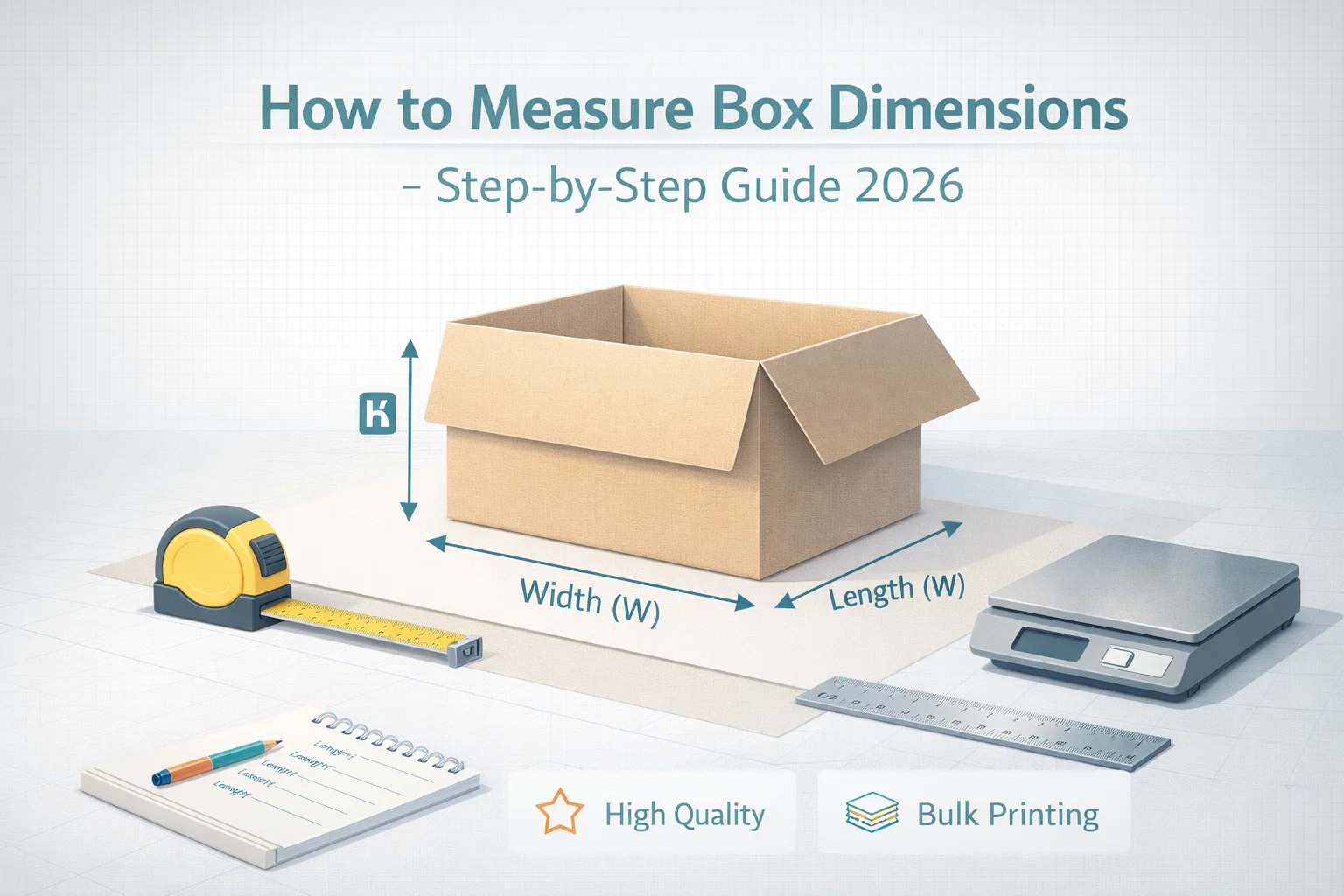
If you don’t know how to measure box dimensions, you must know about the length, width, and height of your product. Hence, these are the key parts for measurements that tell the full story of the boxes.
Then the packaging companies go precise in creating the box, aiming for the product’s shape that covers the space inside. Think of the custom boxes like a 3D rectangle, and let’s cover it.
- Length (L): The length is the longest side of the box, as horizontal cubic meters in the dimension. Imagine a line going from left to right across the top. It is your X index.
- Width (W): The Width is the horizontal measurement of the box from front to back. It shows the depth of the opening. Think of this as your Z index.
- Height (H): Height is the vertical measurement of the box. It goes straight up and down, such as from floor to top. It is your Y index in dimension.
What Tools Do You Need to Measure a Custom Box?
While you are now familiar with the dimensions of the box measurement. But you may now want to know about the tools to measure box dimensions. For that, you need the right equipment by your side.
Here are some essential tools for answering how to measure box dimensions you must know.
- Tape Measure: It is the most common tool for measurement in terms of cubic feet, inches, or meters. However, it is flexible and long, which makes it ideal for doing measurement of the large folding cartons. The metal hook at the end helps you grab the edge properly.
- Ruler: Such a sturdy ruler is good for small, rigid boxes. It stays straight and flat, which makes it very easy to read. Meanwhile, use it for the shorter boxes, usually less than the 12-inches.
- Pen and Paper: The most important thing for writing the measurement is the pen and paper. Write immediately what you measure and make it easy for you to remember.
- Level Surface: A flat floor and the table are important for the precise results. Hence, it prevents product titling that makes it easier for accuracy.
How to Measure Dimensions of a Box?
Mastering the art of box measurement is a vital skill that leads to creating perfect wholesale shipping boxes. By following a clear sequence, you ensure your items remain secure and affordable.
These simple steps turn basic customized cardboard boxes into a perfectly calculated package.
Step 1: Place the Box on a Flat Surface Step
Find a sturdy and level area, like a table or hardwood floor. Ensure the box does not tilt during measurement. A steady base is the secret to getting a truly accurate reading.
Step 2: Measure the Length
Identify the longest side of the box opening at the top. However, extend the tap measure from one corner to the other. If the boxes are small, then you can use the roler as well.
Step 3: Measure the Width
Locate the shorter side of the box opening next. Measure across this horizontal edge to see how deep the box is. It tells you side to side distance of the custom packaging box footprint.
Step 4: Measure the Height
Height is important for learning how to measure box dimensions. Place your tool vertically against the side of the measuring box. Write the measurement from the top of the box to the bottom accurately. It describes the vertical depth of the box.
Step 5: Write Dimensions in Correct Order (L × W × H)
Organize your findings into the universal shipping format. Always list the Length first, followed by the Width, and finally the Height. This standard system helps everyone understand your package size instantly.
Box Dimension Formula Explained 2026
The box dimension formula is a simple mathematical rule used worldwide. It allows you to calculate the total physical volume of your container. However, this calculation is the first step in determining how much space your box occupies.
Furthermore, if you want to find the total volume, you multiply the measurements you have. Hence, the standard formula is Volume = Length × Width × Height.
Let’s do that practically:
Suppose that custom Pizza packaging boxes have a length of 12 inches. Also, a Width of 8 inches and a Height of 5 inches. To find the total volume, you can multiply all of these numbers like this:
12 × 8 × 5 = 480
However, the final result is 480 cubic inches. It tells the wholesale packaging supplier, such as USPS, exactly how much space is required.
How to Measure Box Dimensions for Shipping
Always measure from the outermost edges of the cubic box. It may include the flaps, ape, or slight bulges caused by the items inside.
If a side curves outward, measure from the furthest point to the opposite edge. However, it ensures your box fits into the carrier’s sorting machine without any issues.
How to Measure the Inside of a Box
When doing measurements, you do everything precisely. Sometimes, it is necessary to measure the box inside to ensure the product isn’t too tightly placed.
Take the tape and find the distance of the box from one surface to another inside the box. However, this way you will get how much space is available while ignoring the thickness of the card.
Measuring Irregular or Odd-Shaped Boxes
Want to know how to measure the odd-shaped or unique irregular boxes? To measure an odd shape, you must treat it like a standard rectangle. Imagine the item is sitting inside a clear and straight-edged box.
However, this invisible boundary represents the total space the object occupies. You must find the maximum distance between the furthest points in every direction.
Measuring the curves or dips of the material will result in an incorrect size. Therefore, always focus on the outer limits to ensure your package fits on a shipping truck.
Here are some key points to measure irregular box shapes.
- Measure the Widest Point
- Identify the Longest Edge
- Find the Tallest Vertical Point
- Include All Bulges and Flaps
- Disregard Any Inner Curves
- Account for Handles or Parts
Common Mistakes to Avoid When Measuring Box Dimensions
Sometimes people ask how to measure shoe box dimensions and also how to avoid common mistakes while doing measurements. However, even experts make mistakes during the measuring process.
Staying aware of these frequent slips will save you a lot of trouble. Avoid these common pitfalls to keep your shipping process smooth.
- Mixing the Order: After measurement, always list the dimension as Length, then Width, and then the Height of the box.
- Measuring the Inside: When doing measurements inside the box, also measure the outside as well to save on the cost.
- Ignoring the Bulges: Always remember, don’t skip the widest part of a stuffed box.
- Forgetting the Flaps: Also, ensure that all cardboard flaps are closed before measurement.
- Rounding Down: You must always round your measurements up to the next whole number. However, if your measurement is only a tiny bit over, like 10.1 inches, you should write it as 11 inches.
Quick Measurement Checklist
Before you seal your package, take a moment to review your work. A quick final check ensures your dimensions are perfect for the FedEx carrier.
However, such a simple habit prevents costly shipping errors and keeps your items moving smoothly.
Here is a quick measurement checklist:
- Place the box on a flat surface
- Measure the outside edges only
- Include all the bulging parts or flaps
- Round every number upto the next inch
- Write the dimensions as L×W×H
Final Thoughts
This guide is all about how to measure box dimensions. Mastering this is a simple skill that makes a massive difference. By following the above given easy steps, you can ensure every box is secure and perfect for each product.
Accurate numbers save you money and keep your products safe from damage. You now have the power to create the perfect fit for any item you ship. If you are working with specialized liquid packaging, you can also learn how to measure milk carton dimensions to ensure your custom templates are spot on.
FAQ’s
What is the correct order of box dimensions?
The correct order is always L × W × H. You start with the longest horizontal side, move to the shorter horizontal side, and finish with the vertical height.
Do you measure a box from inside or outside?
Outside measure of the box is important. However, it includes the thickness of the cardboard and any parts that stick out, like tape or bulges.
How do shipping companies calculate box size?
Companies use dimensional weight to find the total volume of your package. Hence, they multiply the Length, Width, and Height by the volume of the corrugated boxes occupied.
What happens if you measure a box wrong?
Measuring the dimensions of the box incorrectly makes your product fit loosely or tightly. Which directly impact on the product quality or originality. Hence, the wrong measurement can also jam the automated machine as well.