Skip to content

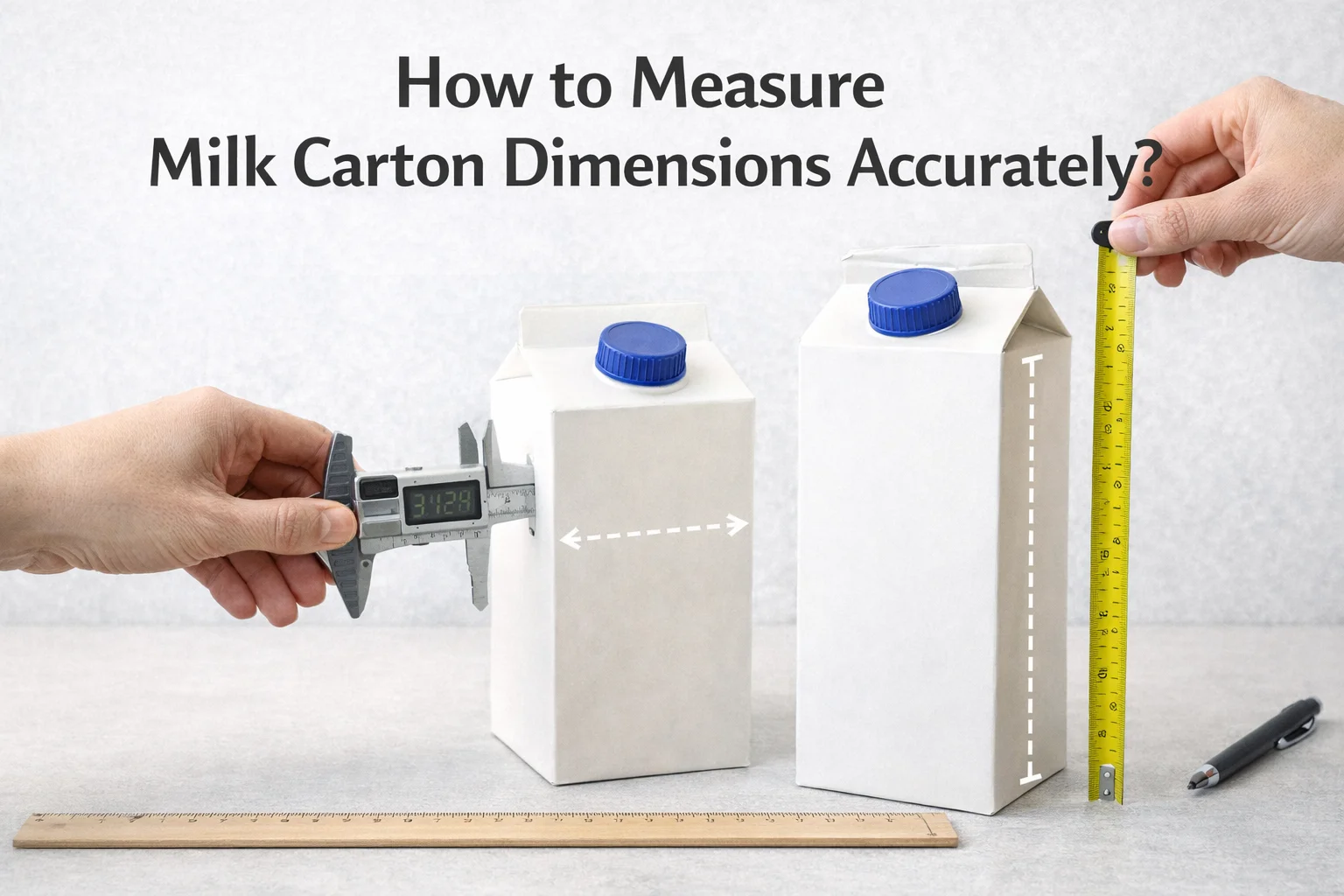
Accurate milk carton dimensions directly impact the packaging cost, branding, and shipping. Incorrect dimensions consume extra space during shipping and affect how much you spend on making the packaging. To measure a milk carton correctly, use a measuring tape or calibrated ruler to determine its length, height, and width, excluding its flaps. If you are a dairy farmer or a large company, you need to know the physical specifications of the milk box to keep the milk fresh.
In the industry of liquids, small errors in dimensions can cause leakage. Even a few millimeters of difference in size leads to structural collapse under weight or failing to fit in the cardboard boxes. This guide explains carton sizes and how to measure them perfectly.
Why Accurate Dimensions Matter?
The right size of a carton means its functionality. Carefully taken measurements are important for several reasons.
Structural Integrity
Milk is a heavy product, and it puts pressure on the walls of the box. If milk carton dimensions are not calculated correctly, then the cardboard may bulge or burst. The weight of stacked cartons also adds up. If the bottom boxes aren’t sized to handle the load, they will crush.
Shipping Efficiency
Logistics providers use standard crate sizes. If your carton is slightly wide, it would not fit in the crates. This makes shipping more expensive. Efficient sizing helps you to move more products for less money.
Shelf Presence
Stores have limited space in the fridges. If your carton is too tall, it might not fit on the shelf. It can lead to the loss of sales opportunities. Grocers prefer boxes that fit their layout without a struggle.
Material Waste
Making an oversized box means use of extra paperboard and costs more money. It also creates more trash for the planet. Using the exact amount of material needed is better for your budget.
Leak Prevention
In a milk carton, proper alignment of these folds and seals prevents leaks. Gussets are the folded sections at a milk carton’s sides or bottom that give it shape and strength. Bad measurements create weak spots in the corners that cause leakage. A tight fit ensures the milk stays inside until the customer opens it.
Milk Carton Measurement Basics You Need to Know
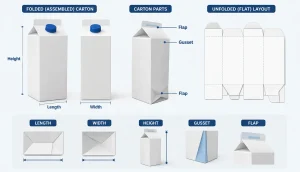
Before measuring a carton, manufacturers and designers need to understand the standard words and measurement terms.
- Length: The longest horizontal side of the box base when viewed from the front of the carton.
- Width: This is the shorter horizontal side of the base. It defines the depth of the container.
- Height: The vertical measurement from the base to the top edge. For gable top cartons, this includes the roof. It is a vertical space that a box takes up.
- Gusset: Folded panels that keep the upright and strong are called milk carton’s gussets. They allow the top of the box to be squeezed together for sealing and pulled apart for pouring.
- Flap: The sections of the cardboard that are folded over and glued to create a liquid-tight seal at the bottom and top.
- Folded Dimensions: The measurements of the carton once it is fully assembled and glued, ready to be filled.
- Unfolded (Flat) Dimensions: The size of the flat sheet before any folding. This is the map used for printing. Designers use this to place logos and text in the right spots.
Custom Milk Carton Sizes in Inches
In North America, the Imperial system remains the standard for dairy packaging. Below are the common milk container sizes used in the industry.
| Milk Carton Size | Volume | Dimensions (L × W × H) | Description |
| Half Pint | 8 oz | 2.75 × 2.75 × 4.0 in | Standard mini milk carton, often in school cafeterias |
| Pint | 16 oz | 2.75 × 2.75 × 7.5 in | Same base as half pint, taller for more milk |
| Quart | 32 oz | 2.75 × 2.75 × 9.5 in | Popular for specialty milks and creams |
| Half Gallon | 64 oz | 3.75 × 3.75 × 9.5 in | Most common household size |
With these dimensions, you can create customized milk carton packaging that fits your product perfectly.
Customize Milk Carton Sizes in Centimeters
Other countries use the metric system. These are the standard sizes for international markets.
| Milk Carton Size | Dimensions (L × W × H) in cm | Description |
| 250 ml | 6.3 × 5.1 × 10.5 | Brick pack, often used for juice or portable milk |
| 500 ml | 7.0 × 7.0 × 15.5 | Versatile mid-size container |
| 1 Liter | 7.0 × 7.0 × 22.5 | Global standard for milk liters |
| 2 Liters | 9.5 × 9.5 × 24.5 | Similar to a US half-gallon, slightly taller and narrower |
| 250 ml | 6.3 × 5.1 × 10.5 | Brick pack, often used for juice or portable milk |
How Milk Carton Shape Changes the Size
The shape of the box depends on how you measure it. Different shapes require measuring length, width, and height in slightly different ways to get accurate dimensions.
Gable Top Cartons
This shape is classic with a pointy roof. When measuring these, the height must include the peak. Because the top is tapered, but the actual space for milk is lower than the total height. These usually have a square bottom to ensure stability. For branded packaging solutions, explore our custom gable boxes that combine functionality with attractive design.
Brick Pack Cartons
Brick packs are six-sided rectangles. These boxes are made for long-life milk and are easily stackable on top of each other. This saves space during shipping and is mostly used for milk that doesn’t need a fridge until it is opened.
International Milk Carton Sizes
Different countries have slightly different standard milk carton dimensions:
| Region | Common Milk Carton Sizes |
| US | Half pint, Pint, Quart, Gallon |
| EU | 200 ml, 500 ml, 1 L, 2 L |
| Australia | 250 ml, 500 ml, 1 L, 2 L |
By knowing these standards, brands can adjust milk carton sizes for multiple markets without redesigning packaging from scratch. We can help you customize your printed milk carton packaging to fit any volume.
How to Measure Milk Carton Dimensions
Measure from the middle of the folds for the best results. The thickness of the cardboard can change the numbers if you measure from the outside.
Tools Required to Measure a Milk Carton Box
You do not need fancy gear to get started measuring. You just need a few basic items which are:
- Measuring Tape: Good for large cartons or rolls of material.
- Ruler: A stiff ruler is best for small milk cartoon sizes.
- Digital Caliper: Use this if you need to measure the thickness of the cardboard.
Measuring When the Box is Assembled
To get the outer dimensions, measure the box while it is full or popped into shape.
- Start with the base for length and width.
- Measure from the bottom to the highest point for the height.
- Do not include the plastic cap if there is one.
Measuring When the Box is Flat or Unfolded
If you are designing the artwork, you need the flat dimensions.
- Put the carton completely flat on a table.
- Measure the total width from edge to edge.
- Measure the total height, including all flaps.
- Mark where the fold lines are so the printer knows where to crease the paper.
Start with Packaging House US Today?
Packaging House US offers unique boxes that make your milk brand stand out. Our team understands the science of paperboard. We ensure your cardboard milk carton dimensions are exact for every badge of production. We use high-quality materials that prevent soggy corners and leaks. This keeps your product safe and your brand looking sharp.
For expert guidance or a quick quote, reach out today. You can email us at info@packaginghouseus.com. Our team is ready to help you create packaging that works better for your business.
FAQs
What is the difference between inner and outer dimensions?
Outer dimensions define how much space the box takes up on a shelf. Inner dimensions make it clear how much space is available for the liquid. The difference of inner and outer dimensions clearly shows the thickness of the cardboard.
How to calculate the volume of a milk carton box?
The volume of a carton box shows how many ounces are in a carton. To find out the volume of a cubic box, this formula is used:
Volume= Length * Width* Height
What is the difference between a gable top and a brick pack cartoon?
A gable top has a peaked roof that you pull open to pour. A brick pack is a rectangle with a flat top, often used for long-life milk. Brick packs are easier to stack for shipping, while gable tops are easier for kids to use.