Skip to content


To measure a box correctly, place it with the opening facing up. Measure the longest side of the base for length, the shorter side for width, and the distance from the bottom to the opening for height. Always write it in that order: length x width x height (l x w x h).
If you’ve ever paused over which side is which, you’re not alone, it trips up even people who order packaging regularly. Get the order right, though, and it protects you from oversized boxes, higher shipping costs, and products that don’t sit the way they should.
What Does L x W x H Mean?
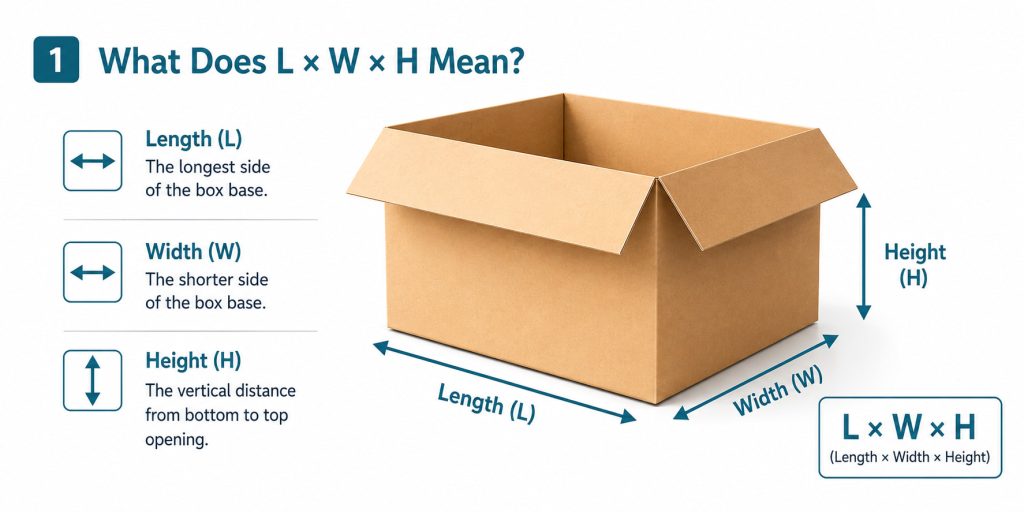
These three measurements sound simple, but mixing them up is one of the most common mistakes buyers make when ordering custom packaging. Length is always the longest edge of the box’s base. Width is the shorter edge next to it. Height is the vertical distance from the bottom of the box to the top opening, not the diagonal or the depth of a lid. Once you can identify these three edges on any box in front of you, the rest of this guide is just reinforcement.
A helpful way to remember it:
- Length: This is always the longest edge of the box’s base panel. We identify this number first because it establishes the primary axis of the package.
- Width: This is the shorter edge of the base panel, running completely perpendicular to the length line. Taken together, length and width tell you the total flat footprint your box occupies.
- Height: This is the vertical measurement from the bottom floor up to the top rim.
This gets slightly trickier with boxes that are nearly square, where length and width look almost identical at first glance. In those cases, measure both edges even if they seem the same, a difference of even a quarter inch matters once you’re ordering in bulk, since it changes how the box nests with others on a pallet or shelf. When in doubt, measure twice and write both numbers down before you move on to height.
Why Box Dimensions Are Written as L x W x H
There’s a reason length width and height always appear in that specific order rather than however feels natural to you. Suppliers, freight carriers, and manufacturers all quote and label boxes the same way, so if the order gets scrambled, you can end up with a box that’s the wrong shape even though the three numbers were technically correct. Writing length x width x height consistently protects you from that mix-up, especially when you’re comparing quotes from more than one supplier.
This matters just as much when someone hands you a set of numbers to work from. If a supplier or template asks you to read the following measurements and plug them into a form, don’t assume the order. Confirm which number is length, which is width, and which is height before you submit anything, particularly for a length width height box you haven’t ordered before. A five-second check here can save a reorder later.
Step-by-Step Guide to Measuring a Box
Instead of looking at abstract drawings, let’s walk through how to measure two common, everyday retail items to see how these rules work in the real world.
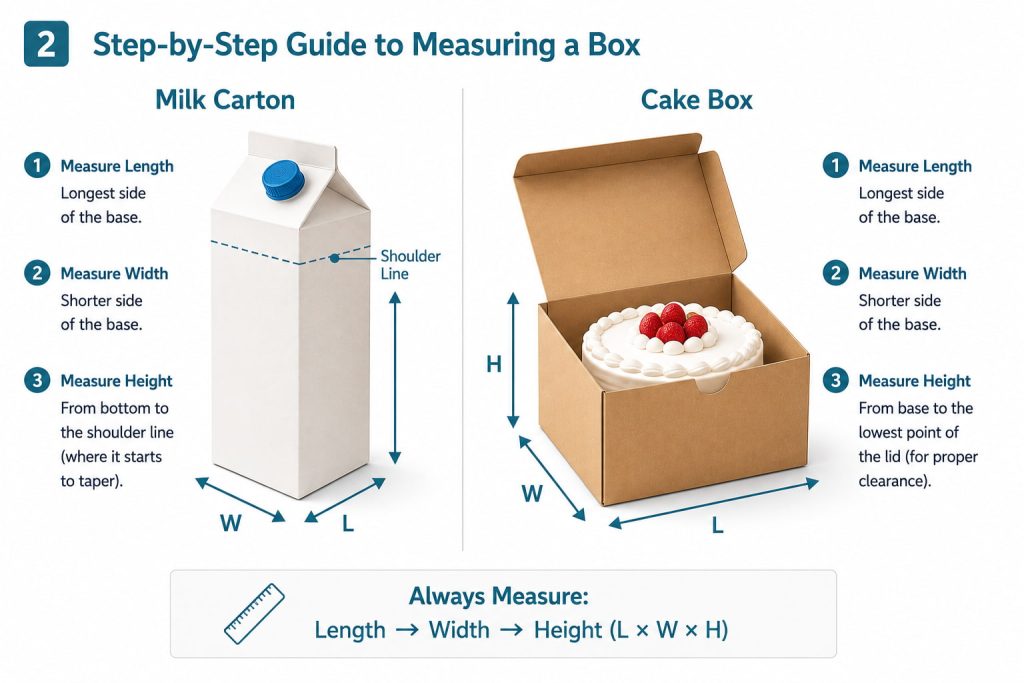
How to Measure Milk Carton Dimensions
A milk carton is unique because it has a flat, square bottom but tapers into a pinched ridge at the top. To measure this style of consumer package, ignore the top ridge entirely at first. Stand the carton upright on a table. Measure the longest side of the square bottom for your length, and the shorter side for your width. For the height, place your ruler inside the carton and measure from the bottom up to the straight “shoulder” line—the exact point where the carton begins to angle inward. Measuring past this point into the tapered top ridge will give you inaccurate space calculations.
How to Measure Cake Box Dimensions
A cake box represents the exact opposite structural challenge: it is a wide, shallow container. When calculating cake box dimensions, your length and width will be much larger than your height. Open the lid and measure the flat square base panel from corner to corner to get your footprint. When tracking the height, you must consider structural clearance. Bakery items require vertical breathing room for thick frosting, delicate decorations, and toppers. Your height measurement must reflect the exact vertical distance between the base floor and the lowest folding tab of the lid to ensure nothing gets crushed when the box is closed.
Measuring Odd Shapes and Special Boxes
When your packaging moves away from a standard six-sided cube, finding a clean l x w x h answer requires a bit of adaptation.
Tapered or Angled Boxes
If you are using a box where the top opening is wider than the bottom base, always take your measurements at the widest point of the container. Note both numbers in your design brief so your production team can account for the slope of the walls.
Round or Cylindrical Packaging
For tubes, drums, or round jars, your length and width blend together into a single number: the diameter. However, even on round items, a custom packaging manufacturer will still ask for three dimensions. In this scenario, you simply enter the diameter twice (for length and width) and the vertical depth once (e.g., Diameter x Diameter x Height). This helps shipping systems calculate how much square room the tube will occupy inside a square shipping carton.
Irregular and Die-Cut Designs
For boxes with built-in display windows, auto-lock bottoms, or integrated presentation headers, it is best to track two separate sets of numbers. Note the flat, unfolded dimensions of the cardboard sheet, and list the final assembled dimensions separately. If your packaging utilizes multi-panel gussets that expand when filled, your width will mean two different things depending on whether the box is stored flat or popped open on the fulfillment line.
Internal vs. External Dimensions: Why It Changes Your Order
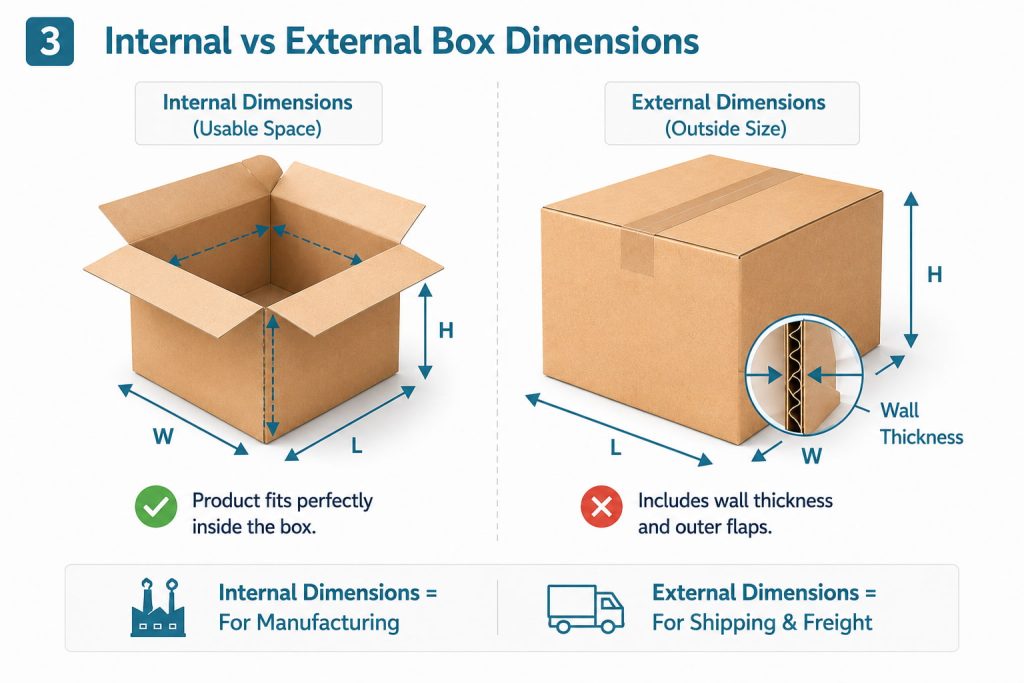
One of the most expensive mistakes a business can make is confusing internal room with external volume. Manufacturers quote and build packages based strictly on internal dimensions. This ensures that whatever product you are selling actually fits inside the usable space. External dimensions, on the other hand, measure the outside edges of the box, which include the thickness of the cardboard walls and any overlapping closure flaps.
If you are shipping items in a heavy, double-walled corrugated box, those thick material layers can easily shave a quarter-inch or more off your interior space. If you submit external measurements by mistake, your final boxes will turn out too small for your inventory. As a universal rule of thumb, always add a clearance buffer of roughly 1/8 of an inch ($0.125″$) to your product’s raw dimensions so your fulfillment team doesn’t have to wrestle items into the packaging.
Common Measurement Mistakes
A handful of small errors show up again and again, and most of them are easy to avoid once you know to look for them.
- Measuring with the box assembled at an angle, which distorts the height reading
- Confusing length and width on boxes that are nearly square, where the difference isn’t obvious at a glance
- Forgetting to account for lids or flaps, especially on gift or bakery boxes where the lid adds height once it’s closed
- Using a soft tape measure that sags, which quietly adds fractions of an inch to longer measurements
- Measuring product dimensions and box dimensions interchangeably, without leaving room for clearance
Catching these before you submit an order is far easier than catching them after the boxes arrive.
How Box Dimensions Affect Shipping Costs
Shaving a few millimeters off your box dimensions isn’t just about neat design—it is about protecting your bank account. Major carriers like FedEx and UPS use Dimensional Weight (DIM Weight) scanners. They don’t just weigh your box; they measure its total footprint. If your container is full of empty space, you are stuck paying premium freight rates to ship nothing but trapped air.
Think about the math the shipping companies run: (Length x Width x Height) divided by 139. That total equals your billable weight. If you rely on lazy, oversized stock boxes, your packing crew will burn through cash buying bubble wrap, tissue paper, and foam peanuts just to stop items from rattling around inside.
Custom packaging completely cuts out those hidden fees. Instead of forcing your products into a generic box, a dedicated manufacturer shapes the cardboard directly around your item’s blueprint. You save warehouse space, stack pallets tighter, and stop overpaying on shipping labels.
Ready to Get Your Dimensions Right the First Time?
Getting your length, width, and height locked down on day one keeps your supply chain clean and avoids the nightmare of paying for a massive batch of unuseable boxes. Your packaging should fit your product perfectly, protect your bottom line, and look professional at delivery. If you’re planning a custom order and want a second set of eyes on your measurements, our team is glad to help you confirm dimensions, review clearance, and make sure your first order is also your last revision.
FAQ’s
What is the correct order of box dimensions?
The correct order is always L × W × H. You start with the longest horizontal side, move to the shorter horizontal side, and finish with the vertical height.
Do you measure a box from inside or outside?
Outside measure of the box is important. However, it includes the thickness of the cardboard and any parts that stick out, like tape or bulges.
How do shipping companies calculate box size?
Companies use dimensional weight to find the total volume of your package. Hence, they multiply the Length, Width, and Height by the volume of the corrugated boxes occupied.
What happens if you measure a box wrong?
Measuring the dimensions of the box incorrectly makes your product fit loosely or tightly. Which directly impact on the product quality or originality. Hence, the wrong measurement can also jam the automated machine as well.